
Max Bradley

Max Bradley

Postdoctoral Researcher, Brown University
About

I am a Postdoctoral Research Associate at The Watson School of International and Public Affairs at Brown University, where I am affiliated with the Climate Solutions Lab. My research sits at the intersection of political economy and political behaviour. I study the politics of the green transition, focusing on how different actors respond to and are shaped by decarbonization policies. I emphasize the role of economic geography, human capital, and education in shaping these dynamics. More broadly, my work connects the literatures on distributive conflict, climate politics, and comparative political economy. Methodologically, I employ causal inference techniques with observational data, field and survey experiments, and qualitative interviews. My work has been published in the Proceedings of the National Academy of Sciences and the European Journal of Political Research.

I completed my doctorate in Political and Social Sciences in 2026 at the European University Institute. In 2024, I was a Junior Visiting Scholar at Nuffield College, University of Oxford. I also hold an MSc in Political Science from Leiden University and a BA in Economics from Trinity College Dublin.

Publications

Peer-Reviewed Articles

Educational Policies Can Strengthen Climate Coalitions (with Rens Chazottes, Susanna Garside, and Nina Lopez-Uroz).
Proceedings of the National Academy of Sciences, 2026: 123(20), e2533821123. Journal link

Abstract
Building public support for ambitious climate policies is a central challenge for governments seeking to decarbonize their economies. Many climate change mitigation policies impose visible material costs on citizens, and governments have limited fiscal capacity to deploy compensatory measures. Education is often used as a tool to build public awareness about climate change, but its effect on support for climate policies is not well understood. We evaluate the effects of a climate education policy through the study of a real-world large-scale educational intervention: a 3-h interactive workshop which has so far been implemented in over 500 French universities. We employed a randomized control trial reaching 1,845 students across 167 workshops. Students who took the workshop expressed 7 percentage points higher support for costly climate policies, including a beef tax, short-haul flight ban, and meat-free university canteen, compared with the control group. The workshop increased beliefs in the effectiveness of these policies and elicited more positive emotions about climate action. Evidence from a subsample of follow-up survey respondents suggests these effects may persist for at least 6 wk. We find no evidence that the workshop increases willingness to donate to a climate NGO. Overall, the results suggest that well-designed climate education can play a role in broadening public coalitions for ambitious climate policies by strengthening perceived policy effectiveness and support for costly policies.

Mass attitudes towards Russia's aggression against Ukraine: Tentative support for top-down opinion formation. (with Filip Kostelka, Martín Alberdi, Toine Fiselier, Alexandra Jabbour, Nahla Mansour, Eleonora Minaeva, Silvia Porciuleanue, and Diana Rafailova).
European Journal of Political Research, (2026): 1-26. Journal link

Abstract
This paper studies variation in mass attitudes towards the Russo-Ukrainian War. Although most Europeans express dismay at Russia’s aggression against Ukraine, more ambivalent or even pro-Kremlin positions are not rare. Drawing on the literature on foreign policy and war, we hypothesise that support for the aggressor may stem from a quartet of factors: economic interests, ideological preferences, partisan alignment, and disinformation. We examine the role of these factors using two types of survey data. The first is an original survey conducted in five countries (Czechia, France, Poland, Romania, and Slovakia) and spanning over 12,000 respondents. The second is the Solidarity in Europe survey, with more than 24,000 respondents from seventeen countries. The results of three types of analyses reveal that neutral and pro-Kremlin attitudes, held by sizeable segments of European society, are most strongly linked to the positions of respondents’ preferred political parties, followed by disinformation and ideology. Overall, top-down models of public opinion seem to better explain within-country variations in attitudes towards the conflict than bottom-up models. These findings, which should be interpreted with caution, carry important implications for containing Russia’s influence on European public opinion and contribute to the literature on public preference formation in the field of foreign policy.

The Ethnic Origins of Affective Polarization: Statistical Evidence from Cross-National Data (with Simon Chauchard).
Frontiers in Political Science, 4, 920615 (2022). Journal link

Working Papers

Adapt or Perish: How the Spatial Distribution of Human Capital Shapes the Economic and Political Effects of the Green Transition.

Abstract
What are the economic and political effects of the green transition? Existing re search emphasizes a between-sector logic where firms in high-emitting industries face greater costs from decarbonization policies. I argue that, while this perspective cap tures exposure to the transition, it obscures an important within-sector dynamic the ability of some firms to adapt better than others. I contend that a crucial factor that determines the adaptability of firms is the level of human capital in the local labour force. Access to skilled workers reduces labour-market frictions and enables firms to adapt by adopting greener activities. Where human capital is scarce, firms struggle to adapt, leading to an economic divergence across communities. Using the United Kingdom as a case, I show that following the 2008 Climate Change Act, high emitting firms in high–human capital communities adapted and grew, while those in low–human capital communities declined. This divergence in economic trajectories has political consequences. Residents of exposed, low-human-capital communities display greater support for transition-mitigation policies that compensate high-emitting firms, whereas differences are weaker for transition-acceleration policies such as renewable energy investment and retraining programmes. These patterns are consistent with sociotropic theories in which local economic prospects inform political preferences.

A Threatening Climate: How Material Threat Reshapes the Educational Cleavage.

Abstract
Who supports climate policies and why? While much of the comparative politics literature points to an education-based cleavage in climate preferences and Green party support, recent work in political economy emphasizes the material threats posed by climate policy to workers in high-emitting sectors. This paper reconciles these perspectives by arguing that education-based differences in climate preferences are conditional on exposure to material threat. Using data from eleven rounds of the European Social Survey combined with sectoral-level emissions data from the OECD, I show that educational gaps in support for carbon taxes, green subsidies, and Green parties diminish as material exposure increases, driven by declining support among highly educated workers. Panel analyses using the German Socio-Economic Panel indicate that these patterns reflect preference updating, not self-selection. Together, the findings demonstrate how climate preferences are jointly shaped by material exposure and values-based orientations.

Flood Insurance and Risk Socialization (with Martín Alberdi, Alexandra Jabbour, and Filip Kostelka).

Reducing Gender-Based Polarization: A Field Study in UK Schools (with Henri Pozsar, Marica Miglio, Beth Ginsburg, and Simon Hix).

A Broken Union? Cohesion, Legitimacy, and the Political Consequences of Collective Action .
Teaching & Pedagogical Development
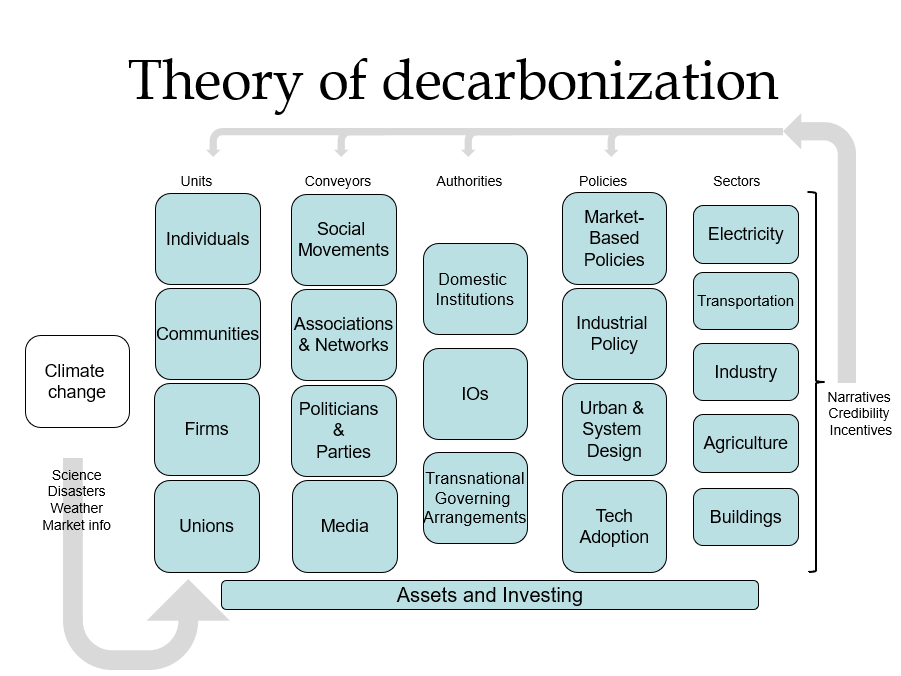
Theory of Decarbonization diagram

Together with Jeff Colgan at Brown University’s Climate Syllabus Bank, I recently designed an approach for teaching the political economy of decarbonization which emphasizes the different theories of change underlying climate action.

Our project introduces a framework that emphasizes different Theories of Decarbonization (see above image) which helps instructors: a) build structured and balanced syllabi, b) map existing theories of change (e.g., Kyoto, Carbon Taxes, Green New Deal), and c) develop hands-on exercises where students trace their own theory of change.

The framework is presented in our short explainer video and detailed in a companion working paper that reviews the literature on the political economy of decarbonization and offers practical guidance for instructors.

News

The first paper of my dissertation was recently awarded the Ireland Thinks Best Paper Prize, which is awarded annually to the best paper delivered by an early-career researcher at the Political Science Association of Ireland (PSAI) Conference.

Read more here.